

Azure B-Series: Burstable VMs That Actually Save Money
B-series VMs use a CPU credit model instead of guaranteed performance. For bursty workloads, that's roughly half the cost of a general-purpose VM. Here's how the credits actually work.
Most workloads don’t need 100% of a CPU, 100% of the time. A web server idles most of the day and spikes during business hours. A domain controller, file server, or print server in a small office sits idle almost all day, waiting for a logon, a file request, or a print job. A dev box sits idle overnight. Azure’s B-series VMs are built around exactly that pattern, and they cost meaningfully less because of it.
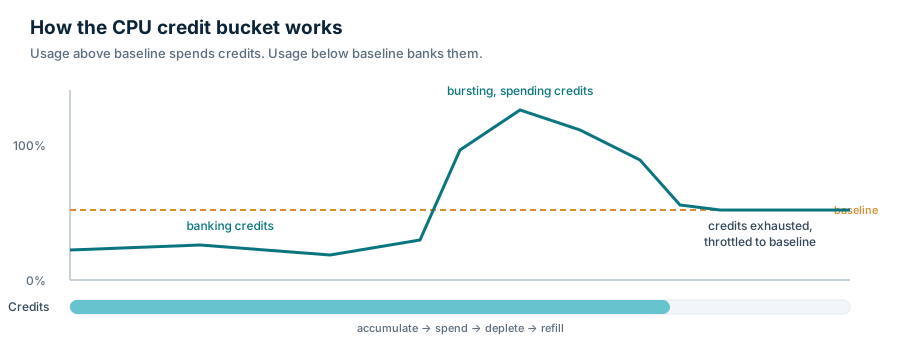
Baseline performance, not guaranteed performance
A standard VM gives you the full compute you’re paying for, all the time. B-series gives you a lower baseline instead, say 20% of a vCPU, and lets you burst above that when you need to.
Every VM tracks this with a CPU credit. Run below baseline and you bank credits. Run above baseline and you spend them. As long as you have credits banked, bursting to 100% costs nothing extra. Run out of credits, and the VM throttles back down to baseline until it accumulates more.
What “running out” actually looks like
This is the part people miss. A B-series VM that bursts constantly, with no idle time to recover credits, gets throttled to baseline and stays there. You picked the credit-based VM to save money. Constant load is where that choice costs you.
For a genuinely bursty workload, with real idle time between spikes, this never becomes a problem: the idle periods refill the bucket faster than the spikes drain it. For a workload that’s busy most of the time, B-series is the wrong choice. You’ll spend your credits and sit at baseline more than you’d like.
What it actually saves you
A B2s (2 vCPU, 4 GB RAM) runs $0.0416 an hour. A D2s_v5 (2 vCPU, 8 GB RAM), Azure’s standard general-purpose size, runs $0.096 an hour. B2s costs less than half.
That’s not a fair fight on memory: B2s has half the RAM. But for a workload where 4 GB is plenty and the CPU sits idle most of the time (small web servers, dev/test, light internal tools), you’re paying 57% less for compute you weren’t going to use anyway.
This is where small shops leave money on the table. A domain controller, file server, or print server for a 10-person office doesn’t need a full general-purpose VM. Authentication, file shares, and print queues barely touch the CPU outside a few busy minutes a day. A B2s handles all three comfortably: about $30 a month instead of $70.
When to skip it
Anything that’s CPU-busy most of the time: a production database under real load, batch processing, a build server that’s always compiling something. You’ll burn through credits and end up throttled at baseline, which is worse than just paying for a standard VM’s guaranteed performance in the first place.
Subscribe for more of these.